

Lane signs in Alberta: turn arrows, dual turns and reserved lanes
Lane signs tell you which way you must go from the lane you are in. Here is every designated lane sign in the Driver's Guide, what each means, and the lane rules that go with them.p. 28
Checked against the Driver’s Guide (Spring 2026) on .
The short version
- Lane control signs are square, with a white message on a black background. The arrow or symbol shows the direction, or directions, you must travel in that lane.p. 25p. 28
- Where dual turns are allowed, more than one vehicle going the same way can turn at the same time. Keep your lane position during and after the turn.p. 28
- Reserved lanes are for certain vehicles, such as buses, taxis and bicycles. The symbol on the sign shows who may use the lane, and a lane reserved only part of the time shows the hours and days.p. 28
- A diamond marking on the road means the lane is reserved for certain vehicles.p. 39
- The turning vehicles yield to bicycles sign may appear where drivers have to cross a bicycle lane.p. 40
What lane signs mean
Lane control signs are square, with a white message on a black background. The Driver's Guide calls them designated lane signs: the message or symbol shows the direction, or directions, a vehicle must travel in that lane.p. 25p. 28
The same idea may also be painted on the road. Arrows on the pavement show the movements allowed in a lane, and pavement symbols can add to the signs or work on their own.p. 39
As you come up to an intersection, always check the signs and pavement markings, and make sure you are in the correct lane to turn or to go straight ahead.p. 66
Turn and straight-ahead lane signs
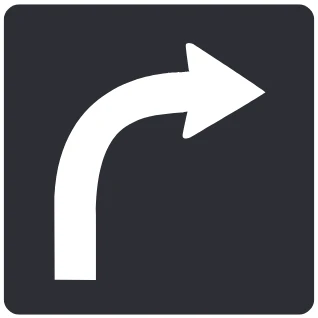 Right turn: traffic in this lane must turn right.Square, white message on a black backgroundp. 28p. 25
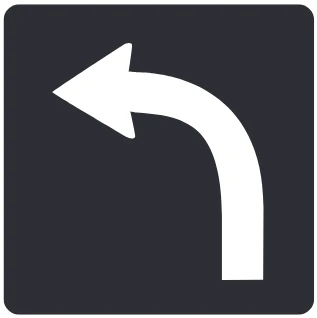 Left turn: traffic in this lane must turn left.Square, white message on a black backgroundp. 28p. 25
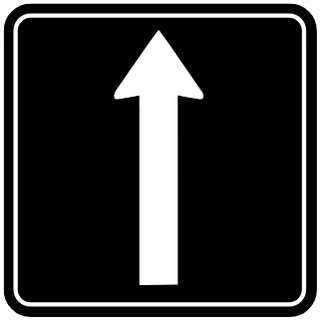 Straight only: traffic in this lane must go straight ahead. No turns from this lane.Square, white message on a black backgroundp. 28p. 25
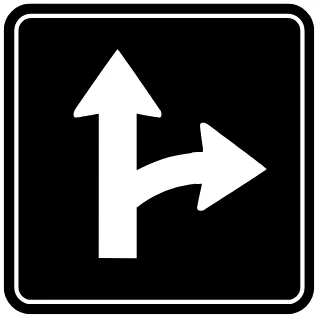 Straight or right turn: from this lane you may go straight ahead or turn right.Square, white message on a black backgroundp. 28p. 25
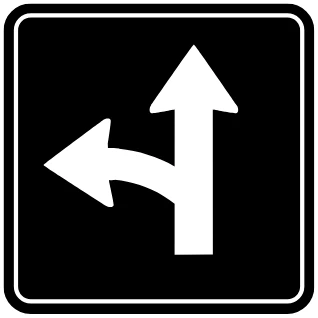 Straight or left turn: from this lane you may go straight ahead or turn left.Square, white message on a black backgroundp. 28p. 25
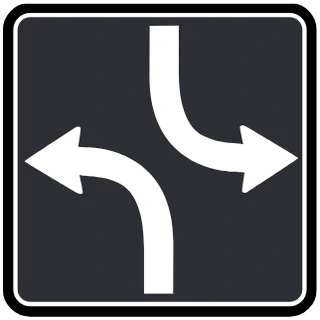 Left turn lane control: the Driver's Guide lists this sign by name only. As on every lane sign, its arrows show the directions a vehicle must travel in the lane.Square, white message on a black backgroundp. 28p. 25
Dual turns and signs for several lanes
Some intersections let more than one vehicle going the same way turn at the same time. These signs show what each lane may do.p. 28
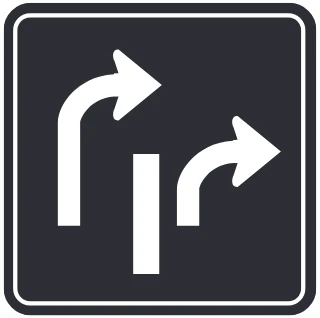 Dual right turn: more than one vehicle can turn right at the same time. Come up in one of the marked lanes, turn into the matching lane and keep your lane position during and after the turn.Square, white message on a black backgroundp. 28p. 66p. 25
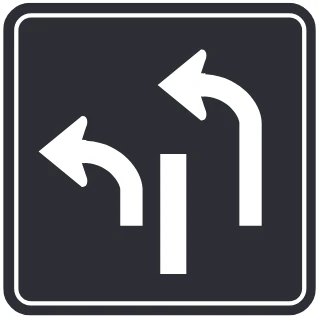 Dual left turn: more than one vehicle can turn left at the same time. Come up in one of the marked lanes, turn into the matching lane and keep your lane position during and after the turn.Square, white message on a black backgroundp. 28p. 66p. 25
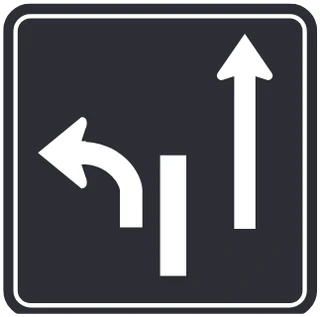 Left lane turn left, right lane straight: from the left lane you turn left; from the right lane you go straight ahead.Square, white message on a black backgroundp. 28p. 25
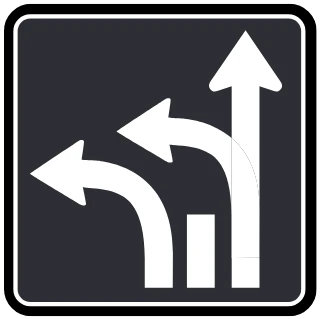 Left lane turn left, right lane straight or turn left: from the left lane you turn left; from the right lane you may go straight ahead or turn left.Square, white message on a black backgroundp. 28p. 25
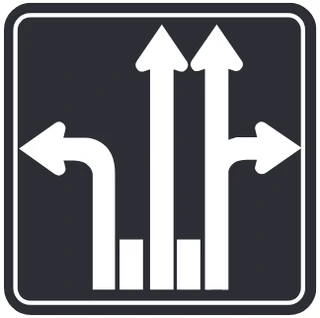 Left lane turn left, centre lane straight, right lane straight or turn right: from the left lane you turn left, from the centre lane you go straight ahead, and from the right lane you may go straight ahead or turn right.Square, white message on a black backgroundp. 28p. 25
How to drive a dual turn:p. 66
- Dual turns can only be made where signs or pavement markings show them.p. 66
- Come up to the intersection in one of the marked lanes and turn into the matching lane.p. 66
- Never swing wide or change lanes during the turn: another vehicle could be turning beside you.p. 66
- Watch the vehicle turning beside you, as it may swing wide into your lane.p. 66
More on turning, dual turns and U-turns: Left, right and U-turn rules in Alberta.
Roundabout lane signs
Roundabouts come in several shapes and sizes, so drivers must watch for and obey the traffic signs and pavement markings there.p. 61
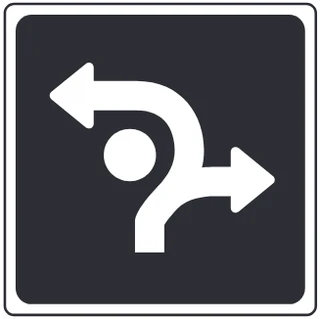 Single lane roundabout: a lane sign for a roundabout with one lane. Yield to drivers already in the circle, and once inside, signal right when you are preparing to exit.Square, white message on a black backgroundp. 28p. 61p. 25
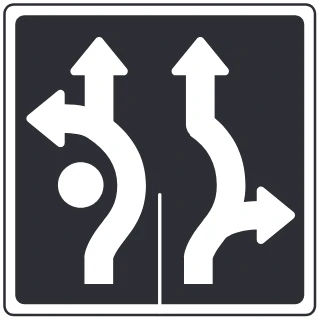 Roundabout dual lane: a lane sign for a roundabout with two lanes. Its arrows show the directions a vehicle must travel from each lane.Square, white message on a black backgroundp. 28p. 62p. 25
Choosing and keeping your lane in a two-lane roundabout:p. 62
- Right lane: enter when it is safe, stay in the right lane while in the circle, and exit using the right lane. Use it when you will take the first exit.p. 62p. 63
- Left lane: enter when it is safe, stay in the left lane while in the circle, and exit using the left lane. Drivers planning to travel past the first exit should use the left lane.p. 62
- Do not change lanes in the circle.p. 62
Step by step, with who yields and when to signal: How to drive through roundabouts and traffic circles in Alberta.
Reserved lanes: buses, taxis and bicycles
Some lanes are reserved for certain vehicles, such as buses, taxis and bicycles. The symbol on the sign shows which vehicles may travel in the lane. A reserved lane may work all the time or only some of the time; if only some of the time, the sign shows the hours of the day and the days of the week.p. 28
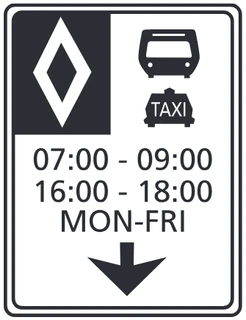 Reserved lane for buses and taxis, with hours and days: the bus and taxi symbols show which vehicles may use the lane, and the times show when the lane is reserved.p. 28
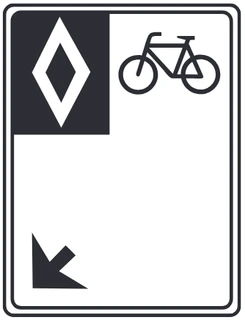 Reserved lane for bicycles: the bicycle symbol shows the lane is for cyclists. The Driver's Guide shows a bicycle lane separated from traffic and parking by solid white lines and marked with a bicycle and a diamond.p. 28p. 40
Look for the diamond. Diamond markings on the road mean the lane is reserved for certain vehicles, and there may also be signs that show the times or the vehicles allowed.p. 39
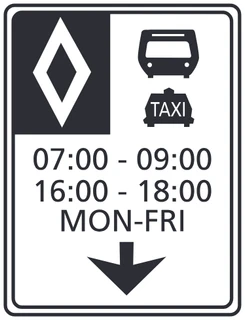 Reserved lane sign (hours and days): the guide shows this same sign again with diamond markings. Signs like it can show the time or vehicle limits for a reserved lane.p. 39
Turning across a bicycle lane
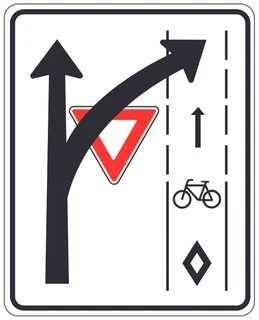 Turning vehicles yield to bicycles: as its name says, vehicles that turn yield to bicycles. The sign may appear at conflict zones, where drivers have to cross a bicycle lane.p. 40
Bicycle lanes and drivers:p. 40
- Vehicles are not allowed to drive in bicycle lanes, except when they need to turn or to enter or leave a parking spot.p. 40
- Be very careful and watch for bicycles when you enter the bicycle lane to turn.p. 40
- Getting ready to turn right? Watch for cyclists riding alongside your vehicle, and shoulder check your blind spots to the right.p. 98
- A bicycle with a pair of arrows above it, painted on the road, reminds drivers to expect cyclists in the same travel lane.p. 40
More on cyclists, pedestrians and large trucks: Sharing the road in Alberta. Lines and pavement symbols: Road lines and pavement markings. Every other sign: Alberta road signs and their meanings and sign shapes and colours. Ready to test yourself? Try the road signs practice test.
Learners ask
Do you have to follow the arrows on a lane sign?
Yes. The message or symbol on a designated lane sign shows the direction, or directions, a vehicle must travel in that lane. As you come up to an intersection, check the signs and pavement markings so you are in the correct lane to turn or go straight ahead.p. 28p. 66
What does a diamond painted on the road mean?
The lane is reserved for certain vehicles. There may also be signs that show time or vehicle limits. On a reserved lane sign, the symbol, such as a bus, a taxi or a bicycle, shows which vehicles may use the lane.p. 39p. 28
Are bus and taxi lanes reserved all the time?
Not always. Reserved lanes may work at all times or only some of the time. A lane reserved only some of the time shows the hours of the day and the days of the week on its sign.p. 28
Can you drive in a bicycle lane to turn right?
Yes, to turn, or to enter or leave a parking spot; otherwise vehicles are not allowed in bicycle lanes. Near corners the bicycle lane line is usually dashed, which shows you may enter the bicycle lane to turn right. Be very careful and watch for bicycles when you do.p. 40
What does the turning vehicles yield to bicycles sign mean?
As its name says, vehicles that turn yield to bicycles. The sign may appear at conflict zones, where drivers have to cross a bicycle lane. Watch for bicycles whenever you enter a bicycle lane to turn.p. 40