

Study guide4 min read
Left turns, right turns and U-turns in Alberta
Many collisions are caused by drivers who fail to turn safely, and poor judgement of time and space on left turns is a leading cause. Here is how to set up and finish each kind of turn.p. 63p. 65
Checked against the Driver’s Guide (Spring 2026) on .
The short version
- Be in the proper turning lane at least 15 metres (50 feet) before the intersection.p. 63
- Don’t turn wide and take up two lanes.p. 65
- Waiting to turn left in the intersection? Keep your front wheels straight, so a hit from behind won’t push you into oncoming traffic.p. 65
- No U-turns at traffic lights (unless a sign allows it), where a sign prohibits them, or, in a city or town, between intersections.p. 67
Signalling
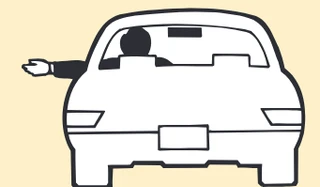
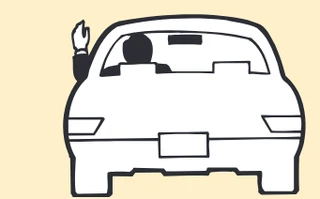
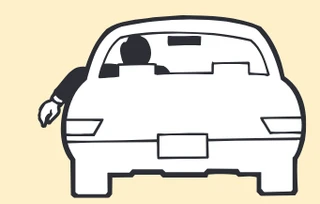
Right turns
- Get ready well ahead. If you’re not in the right lane, check your mirrors, shoulder check, signal and change lanes when safe.p. 63
- The lane by the curb is a curb lane, not just for parking: it is used to turn off and onto a road.p. 63
- From a two-way road onto another two-way road, stay centred in the turning lane, no more than one metre (three feet) from the curb or road edge, before, during and after the turn.p. 64
- Yield to pedestrians and to vehicles on the cross street, and shoulder check right for cyclists and pedestrians coming up to the intersection.p. 64
- Don’t enter the crosswalk to turn until pedestrians are safely out of the intersection.p. 64
- Turn into the first lane on the right, then change lanes later if you need to. If a parked car is close to the corner, turn into the first available lane to its left, yielding to traffic coming from your left in that lane.p. 64
Turning right on a red light: Traffic lights and signals in Alberta.
Left turns
Left turns are risky: traffic can come from several directions, and you cross the lanes of oncoming traffic.p. 65
- Stay behind the crosswalk if there’s only room for one vehicle ahead of you in the intersection. Enter when it clears, if that’s legal.p. 65
- If you must stop in the intersection before turning, stay right of the yellow line with your front wheels straight.p. 65
- Check the crosswalk you’re turning across for pedestrians and cyclists, and look well along your path.p. 65
- Before turning left off a two-lane highway, shoulder check left: someone may be passing you.p. 65
| Turning | From | Into |
|---|---|---|
| Two-way onto two-way | The lane nearest the yellow line, to its right | The lane nearest the yellow line, to its right |
| Two-way onto one-way | The lane nearest the yellow line | The nearest lane on the left side of the road |
| One-way onto two-way | The lane nearest the left side of the road | The nearest lane to the right of the yellow line |
| One-way onto one-way | The lane nearest the left side of the road | The lane nearest the left side of the road |
Every time, yield to oncoming traffic and to pedestrians crossing on your left.p. 65
Dual and shared turn lanes
Check the signs and pavement markings as you approach, so you’re in the correct lane to turn or go straight.p. 66
- Dual turns: only where signs or markings show them. Turn from a marked lane into the matching lane, and never swing wide or change lanes during the turn: someone may be turning beside you.p. 66
- Watch the vehicle turning beside you, in case it swings wide into your lane. If the turn lanes merge afterwards, the driver whose lane ends changes lanes properly.p. 66
- Two-way left turn lane: traffic from both directions shares the centre lane to turn left. You may cross the solid yellow line to enter it, but only close to where you’ll turn, and watch for oncoming vehicles in it.p. 67
U-turns
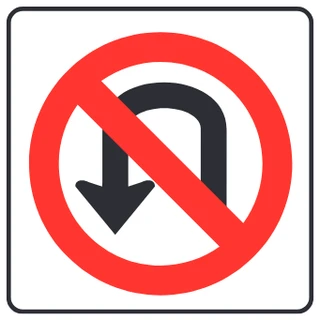 A U-turn turns your vehicle around at an intersection, using the oncoming lanes. Only make a U-turn if it can be done safely.p. 67p. 29
| Where | Not permitted |
|---|---|
| Anywhere | At traffic lights, unless a traffic control device allows it; where a sign prohibits U-turns |
| In urban areas | Between intersections; at an alley intersection; at an intersection with a public or private parking lot entrance that the public can use |
| Outside urban areas | On a curve; approaching or near the crest of a hill where a driver within 150 metres can’t see you |