

Two-lane traffic circle / roundabout (continued)
Vehicle H must yield to Vehicle G.
Exiting circular intersections
Always wait to activate your right turn signal after passing the exit that is before your intended exit. This tells other drivers that you intend to leave the circle at the next exit.
When you intend to exit at the first available exit:
- Approach the circle using the right lane.
- Use your right signal as you approach. Leave it on until you have exited the circle.
- As you approach, scan for pedestrians and cyclists at the crosswalks at the entrance and exits of the circle.
- Yield to traffic in the circle.
- Exit the circle using the right lane.
When you intend to leave at any other exit:
- Approach the circle using the left lane.
- Activate your left signal to communicate that you do not plan to use the first exit.
- As you approach, scan for pedestrians and cyclists at the crosswalks at the entrance and exits of the circle.
- Yield to traffic in the circle.
- Exit the circle using the left lane.
Remember, when you exit using the left lane:
- Use your right signal when you pass the exit that is one before the exit you will use.
- Check for traffic in the right lane that may be continuing around the circle.
- Look ahead for pedestrians at the crosswalk where you will be exiting.
- Exit the circle using the left lane.
- If you cannot stop or exit safely, stay in your lane and travel around the circle/ roundabout again.
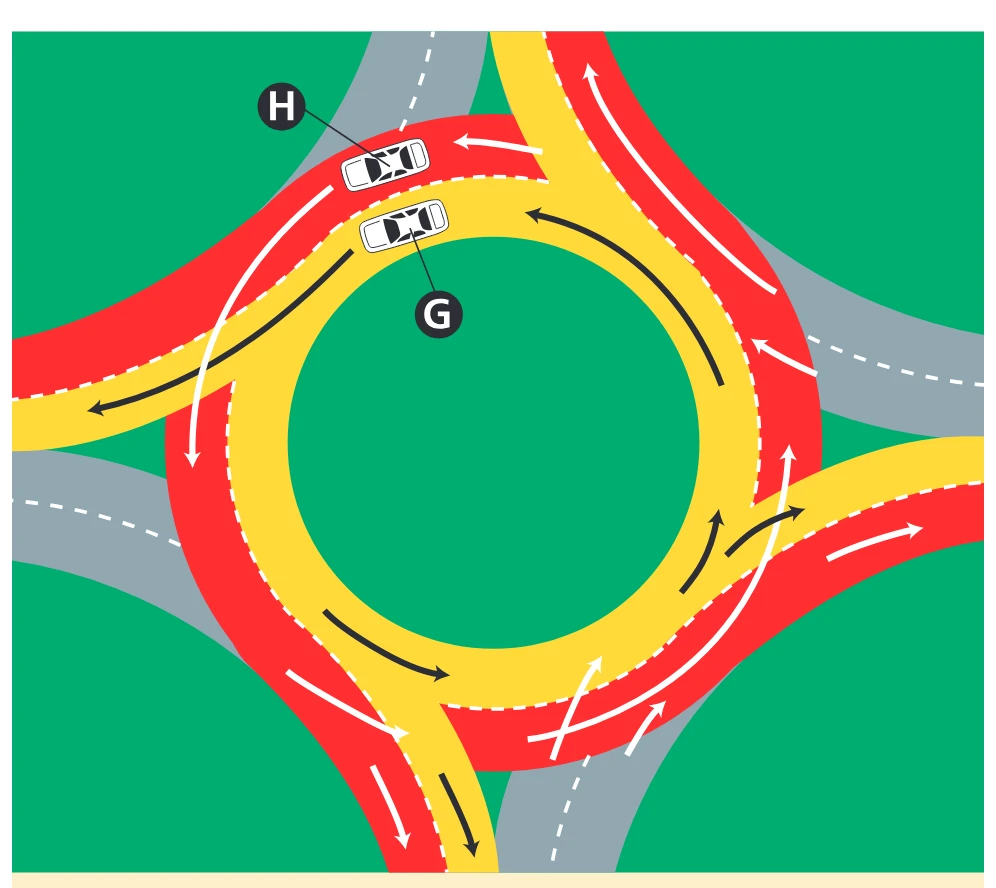
Two-lane roundabout: vehicles G and H
Turning
Many collisions are caused by drivers who fail to turn safely.
Right turns
Remember that travel lanes are not always marked with lines on the road or signs. A travel lane is a section of roadway wide enough to allow the passage of a single line of vehicles. This includes a curb lane lined with parking meters. The lane next to the curb where vehicles park is best referred to as a curb lane, not a parking lane. Curb lanes are not just for parking. They are used to turn off a road and onto a road.
Prepare for a turn well in advance. If you are not in the proper turning lane, check your rear view and outside mirrors and do a shoulder check. Signal and change lanes when it is safe. You should be in your proper turning lane at least 15 metres (50 feet) before the intersection.