

Study guide4 min read
Sharing the road with pedestrians, cyclists, motorcycles and trucks
Pedestrians, cyclists and motorcycle riders share the road with you every day, with much less protection. Large trucks need more room than you might expect. Here is how to share the road with each of them.p. 97p. 99
Checked against the Driver’s Guide (Spring 2026) on .
The short version
- Stopping for a pedestrian at a crosswalk? Stop about two to three car lengths back, so drivers in other lanes can see them too.p. 97
- Pass a cyclist the way you’d pass any vehicle: change lanes. And check for cyclists before you open your door.p. 98
- Never share a lane with a motorcycle: the rider needs the whole lane.p. 99
- Behind a large truck and can’t see both of its side mirrors? You’re too close.p. 99
Pedestrians
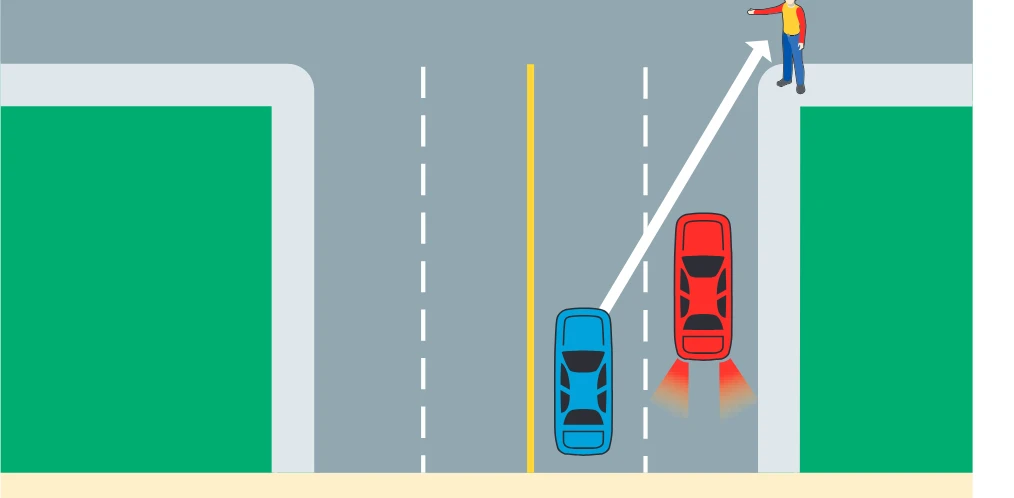
- When a pedestrian signals they want to cross, stop safely before the crosswalk and let them cross.p. 97
- At a flashing yellow pedestrian-activated light, slow to 30 km/h and yield to pedestrians who want to cross.p. 97
- Never pass another vehicle as you approach a crosswalk: it may be slowing for a pedestrian.p. 97
- Not every crosswalk is marked, but follow the pedestrian safety rules at every intersection.p. 97
- Be considerate of visually impaired pedestrians, some of whom use a white cane or a guide dog.p. 97
- After dark, pedestrians are hard to see, especially in dark clothing. Drive so you can stop within the distance your headlights let you see clearly.p. 97
- Children can be unpredictable. In residential areas, glance under parked vehicles for children’s feet, toys and bicycle wheels.p. 97
Who has the right-of-way at crosswalks and intersections: Right-of-way at Alberta intersections.
Cyclists
- A bicycle being ridden is a vehicle: the cyclist follows the rules of the road like any driver. A cyclist walking a bike is a pedestrian.p. 98p. 97
- Cyclists ride as close as practicable to the right curb, but may move out to avoid drainage grates, potholes, debris, gravel, wet patches or ruts.p. 97
- To pass a cyclist, change lanes as you would for any vehicle, and don’t follow too closely: bicycles have no brake lights.p. 98
- Before turning right, shoulder check to the right for a cyclist riding alongside you.p. 98
- Parked at the curb? Check for cyclists before you open your door, and before you pull away. Waiting until it’s safe to open the door is the driver’s responsibility.p. 98
- Give cyclists turning left extra consideration, especially on multi-lane roads: they are smaller, harder to see and more exposed.p. 98
- Watch for children on bicycles: they may not know the dangers, and an oversized bike is hard to control.p. 98
Bicycle lanes and shared-lane markings: Road lines and pavement markings in Alberta.
Motorcycles
- Riders often keep to the left part of their lane to be seen. It doesn’t mean they’re turning left.p. 98
- A motorcycle’s turn signals can be hard to see. Watch the rider: a shoulder check may mean a lane change or a turn.p. 98
- Turning left, look carefully for oncoming motorcycles. They’re hard to see in heavy traffic, at night or at dusk, and their speed is hard to judge.p. 98
- Never share a lane with a motorcycle, and leave extra space when following a rider: motorcycles can stop very quickly.p. 99
- Expect riders to move within their lane to avoid hazards like potholes, and remember that bad weather or road hazards can make them lose control.p. 99
Large trucks and buses
- Blind spots: large vehicles have bigger ones. If you can see the driver in their side mirror, they can see you.p. 99
- Following: leave more time and distance behind a large vehicle, so you can see further ahead and stay clear of rocks it may throw.p. 99
- Stopping: never cut in front of a large vehicle approaching a traffic light; it needs that space to stop. On a hill, leave extra room in front of you, as it may roll back.p. 99
- Passing: you need more time in the oncoming lane, and some trucks pull more than one trailer. After passing, leave extra room before moving back in front.p. 99
- Right turns: stay well back and never drive in the space to the right of a turning truck: you could be squeezed against the curb.p. 99
- Turning onto your road: the truck may need to cross the centre line or use part of your lane. Stop back from the intersection to give it room.p. 100
- Backing up: be careful; if you are too close behind, the driver may not see you in the mirrors.p. 99
- Wind: passing trucks can create strong gusts, especially in a crosswind, that push you within your lane.p. 100
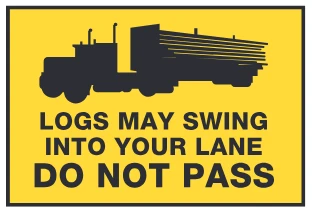 Log trucks: never pass a log truck that is turning off the highway. The logs can stick out up to nine metres (30 feet) behind and block lanes as it turns.p. 100
Oversized loads often travel slowly, sometimes in a convoy with pilot vehicles, and usually pull over to let traffic by. Pass only with enough room and a clear view of oncoming traffic.p. 100