Right-of-way at Alberta intersections
Right-of-way rules decide who must yield and who may go. Signs, signals and sometimes your position relative to other vehicles set the rules.p. 58
Checked against the Driver’s Guide (Spring 2026) on .
The short version
- At a four-way stop, the vehicle that arrived first goes first. If two arrive together, the vehicle on the right goes first.p. 59
- With no signs or signals, yield to the vehicle on your right.p. 59
- Entering a roundabout or traffic circle, yield to traffic already in the circle.p. 61
- Even with the right-of-way, you must still do everything you can to prevent a collision.p. 58
The basics
Stop signs and where to stop
At a stop sign, come to a complete stop. Check the intersection carefully for pedestrians and other traffic, and go only when it’s safe.p. 58
Three- and four-way stops
Yield signs
A yield sign means you must give the right-of-way to vehicles that don’t face a yield sign. Slow down as you near the intersection and be ready to stop for traffic or pedestrians, then wait for a safe gap.p. 59
If there are no pedestrians or traffic you need to yield to, you may carry on through, but approach at a speed that lets you stop easily.p. 59
Intersections with no signs or signals
Some intersections have no signs and no traffic lights. There, you must yield to a vehicle on your right. Check both ways as you approach, and slow down enough to stop easily: fences, trees or parked cars can block your view.p. 59
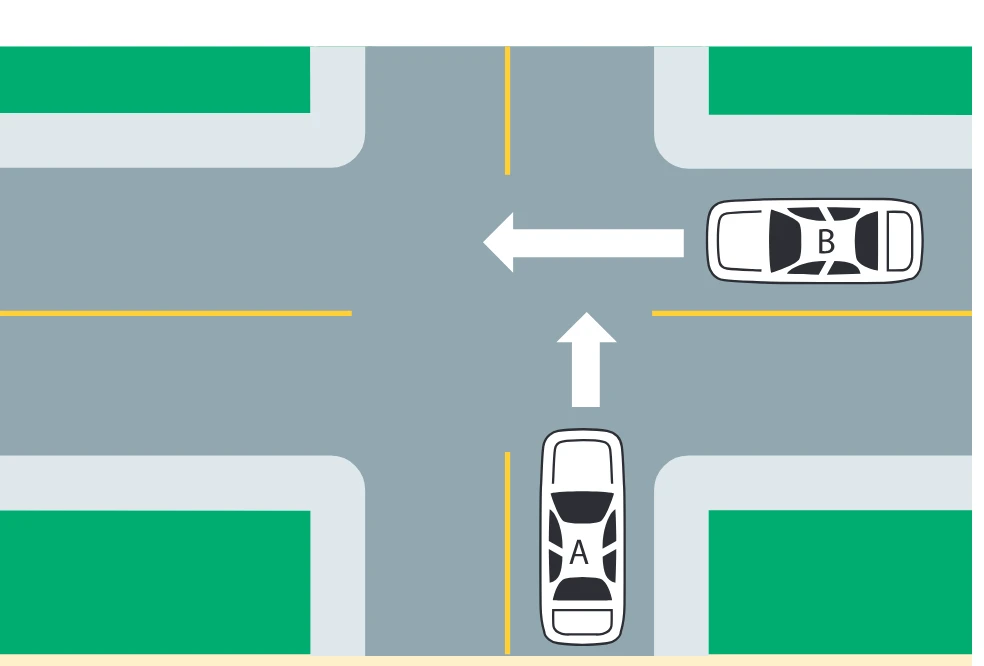
Even when you have the right-of-way, make sure the other vehicle is going to yield before you go.p. 59
The same rule applies at a T intersection with no signs or signals: the driver on the right has the right-of-way. Be careful, because the driver going straight through may wrongly assume it’s theirs.p. 60
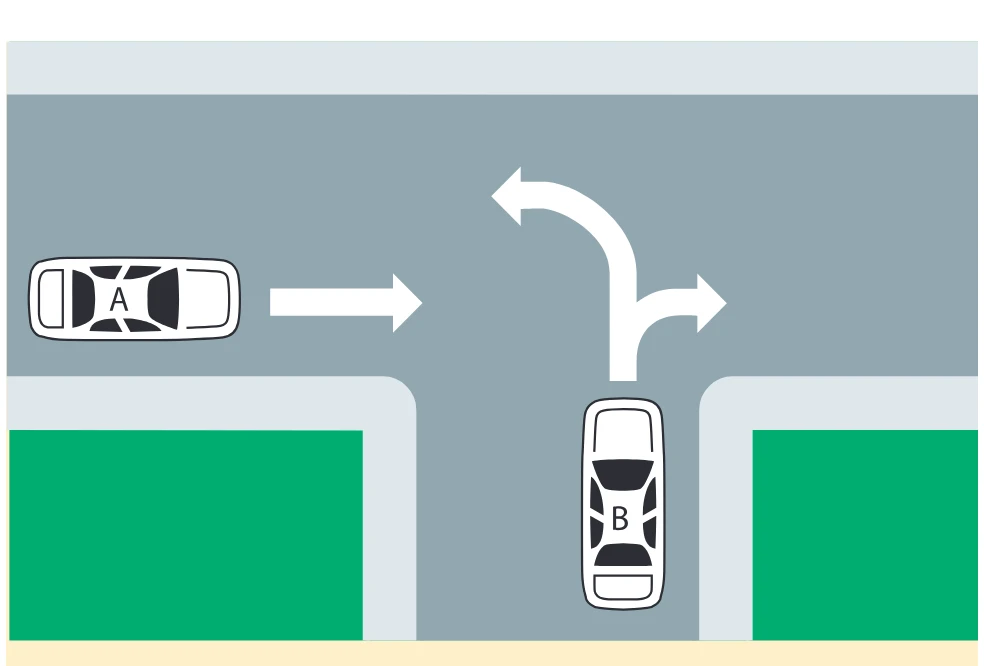
Also remember:p. 60
- Parking lots have intersections without signs or signals, and the right-of-way rules apply there too.p. 60
- Coming out of a service road, alley, parking lot or driveway, stop before any sidewalk crossing, stop before entering the main street, and yield to pedestrians.p. 60
- A driver turning left across the path of an approaching vehicle can’t turn until it’s safe.p. 60
Traffic circles and roundabouts
Traffic always goes counterclockwise around the centre island, and vehicles entering must yield to traffic already in the circle.p. 61
- Turn on your right signal after you pass the exit just before yours.p. 61
- In a two-lane circle, drivers on the right must yield to drivers on the left.p. 62
- Stay in the lane you entered in, and don’t change lanes in the circle.p. 62
- Going past the first exit? Use the left lane to enter and exit.p. 62
- If you can’t stop or exit safely, stay in your lane and go around again.p. 63
Pedestrians and emergency vehicles
- Once a pedestrian has entered a marked or unmarked crosswalk, you must yield.p. 97
- Every intersection has a crosswalk, marked or not. Never pass a vehicle that has stopped for a pedestrian.p. 60
- When an ambulance, fire or police vehicle is coming from any direction with its siren on, yield: pull as close as you can to the right curb or edge (on a one-way street, the nearest curb) and stop until it has passed.p. 85
- Treat a vehicle with flashing green lights like any other emergency vehicle.p. 85
Keep intersections clear
Don’t enter an intersection until you can clear it completely, including the crosswalk on the other side.p. 60