

Vulnerable road users
Pedestrians, cyclists, and motorcycle riders also share the roadways with all vehicle operators on a daily basis. These road users have less protection than drivers of other types of vehicles. Be cautious when operating your vehicle around pedestrians, cyclists, and motorcycle riders.
Pedestrian safety
When you see a yellow flashing pedestrian-activated traffic light, slow to 30 km/h and yield to pedestrians wanting to cross the street.
- In an urban area, pedestrians may indicate their intention to cross a street by raising an arm at a right angle and pointing to the opposite curb.
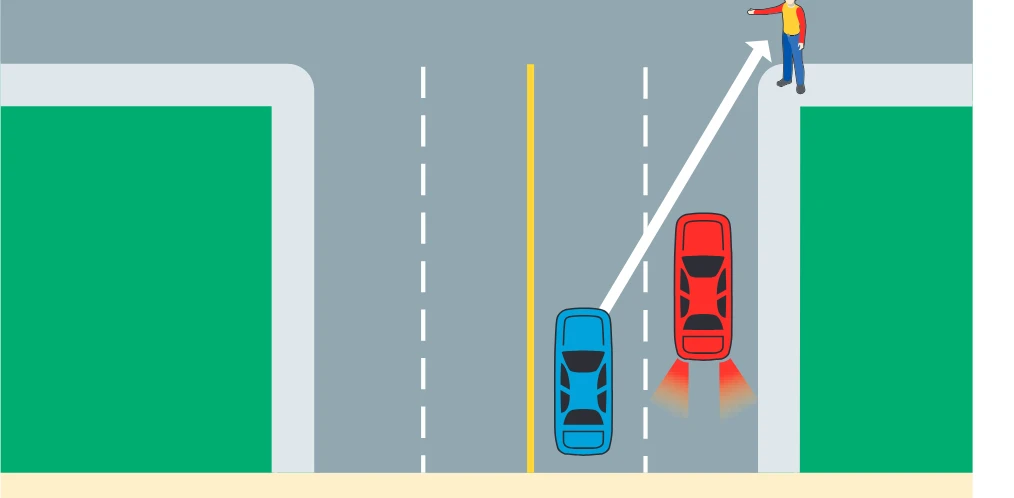
Pedestrian signalling intention to cross
Pedestrian indicating intention to cross the street.
- When pedestrians indicate their intention to cross the street, you must stop your vehicle safely before the crosswalk and allow them to cross.
- When a pedestrian has entered a marked or unmarked crosswalk, you must yield the right-of-way.
- When stopping for a pedestrian at a crosswalk, stop far enough back (about two to three car lengths) so that traffic in other lanes will be able to see the pedestrian and have time to stop.
- Never pass another vehicle when you are approaching a crosswalk. There is always a chance that the other vehicle is slowing or stopping for a pedestrian.
- Not all crosswalks are marked, but the rules of pedestrian safety should be followed at all intersections.
- Be considerate of visually impaired pedestrians. Some will have a white cane or guide dog.
- At night, do not overdrive your headlights. This means you should drive so you are able to stop your vehicle within the distance you can clearly see with your headlights.
- When it is dark, be alert for pedestrians. They can be difficult to see from a distance, especially if they are wearing dark clothing.
- Children can be unpredictable. In residential areas, watch for children around parked vehicles, riding bikes, or playing on the street. Glance under parked vehicles ahead on both sides of the road to check for children’s feet, toys, and bicycle wheels. These provide warning that you may need to stop.
Bicycles
The law requires cyclists or passengers on a bicycle, who are under 18 years of age, to wear an approved bicycle safety helmet.
Tips for sharing the road with cyclists:
- A cyclist who is walking beside and pushing a bicycle is a pedestrian.
- Cyclists are required to ride as close as practicable to the right curb. However, they may need to ride further out when avoiding drainage grates, pot holes, debris, gravel or sand, wet or slippery surfaces, and rutted or grooved pavement. Be aware of the roadway conditions that may affect a cyclist.