

Railway crossings
Never try to outrace a train to a crossing. Trains need a very long distance to come to a stop. Always yield to them. Railway crossings are marked with signs. They can also have mechanical or electrical warning devices.
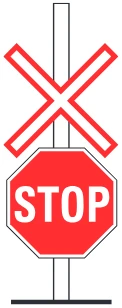
Railway crossing sign with a stop sign
Advance warning signs: These signs tell you to look, listen, and reduce speed because you may have to stop for a train. The speed sign below the advance warning sign is the recommended speed for the railway crossing. It will be less than the posted speed for the road.
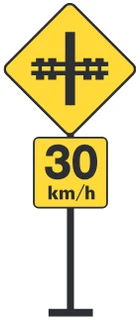
Railway advance warning sign with recommended speed sign
Pavement markings
Pavement markings, such as an X and/or stop line, may be marked on the pavement at the approach to some railway crossings. If you must stop for a train, do it before the stop line.
Railway crossing signs: These signs are found at all public railway crossings. A railway crossing sign means drivers must yield to all trains. If there is more than one railway track, the crossing sign will show the number of tracks. You must stop when a train is visible or sounding a signal and approaching within 500 metres (about five city blocks) of the crossing.
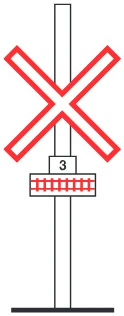
Railway crossing sign showing the number of tracks
Railway crossing signs with a stop sign:
A stop sign at a railway crossing requires the driver to come to a complete stop between five metres (15 feet) and 15 metres (50 feet) from the nearest rail. Do not proceed until you are sure a train is not approaching.