

Study guide3 min read
School buses and railway crossings in Alberta
Students are at risk getting on and off a school bus, and trains need a very long distance to stop. Here are the rules for school buses and railway crossings.p. 101p. 103
Checked against the Driver’s Guide (Spring 2026) on .
The short version
- School bus with red lights flashing and its stop sign out: stop about 20 metres away and stay stopped until the lights go off and the sign folds in.p. 101p. 102
- Amber lights flashing means the bus is about to stop: be ready to stop.p. 101
- At a railway crossing, stop when a train is visible or sounding a signal within 500 metres.p. 103
- Never drive around railway gates, whether they are down, going up or coming down.p. 104
School bus lights
- Amber lights flashing: whichever direction you are coming from, be ready to stop. The red lights are about to start and the bus is stopping for students. If you pass a bus with its amber lights flashing, pass with caution.p. 101
- Red lights flashing, stop sign out on the left side: come to a full stop about 20 metres (about four to five car lengths) away. That distance lets drivers behind you see the lights and the students crossing.p. 101
- Stay stopped until the red lights are off and the stop sign on the driver’s side is folded in.p. 102
Which lanes must stop
| Road | Who stops |
|---|---|
| Two-lane highway, not divided by a median | Both lanes, in both directions |
| Four-lane highway, not divided by a median | All four lanes |
| Highway divided by a median | Vehicles behind the bus. Traffic coming from the front may proceed with caution, watching for pedestrians |
These rules apply whenever and wherever a school bus has its lights on. Some municipalities also have their own rules for school buses.p. 102
Railway crossing signs
Never try to outrace a train to a crossing: always yield to trains.p. 103
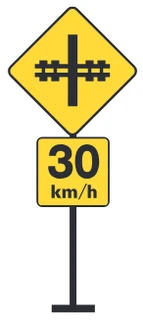 Advance warning sign: look, listen and slow down: you may have to stop for a train. The speed sign below it is the recommended speed for the crossing, lower than the road’s posted speed.p. 103
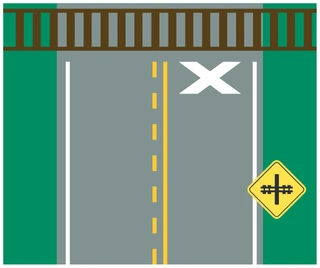 X and stop line on the pavement: if you must stop for a train, stop before the stop line.p. 103
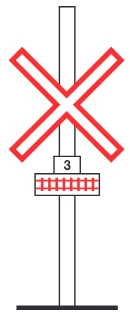 Railway crossing sign: yield to all trains. If there is more than one track, the sign shows how many. Stop when a train is visible or sounding a signal within 500 metres (about five city blocks).p. 103
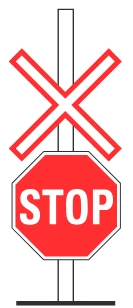 Crossing sign with a stop sign: come to a complete stop between five metres (15 feet) and 15 metres (50 feet) from the nearest rail, and don’t go until you are sure no train is coming.p. 103
Flashing lights, bells and gates
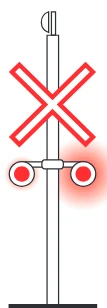 Red lights and bells: stop when they start. The first vehicle stops at least five metres back from the nearest rail. Don’t go until the lights and bells have stopped and the train has passed or stopped. With more than one track, make sure every track is clear.p. 104
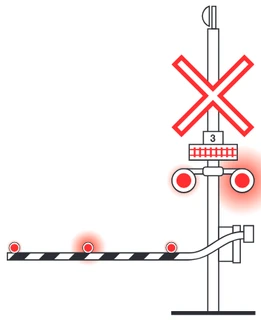 Gates, lights and bells: stay stopped until the gates are up, the lights stop flashing and the bells stop ringing.p. 104
Staying safe at the tracks
- Don’t get trapped on the tracks: wait before the crossing and cross only when you are sure you can clear it.p. 104
- After a train passes, check that no other train is coming. A second train can come on another track, and you may not hear it over the first.p. 104
- With a manual transmission, don’t change gears on the tracks, or you could stall there.p. 104
- If you stall on the tracks, get everyone out and away at once. If a train is coming, move well away, toward the direction the train is coming from, so flying debris doesn’t hit you.p. 104
- A train can need a kilometre or more to stop, even with full emergency braking.p. 104
- Following a commercial vehicle carrying passengers or dangerous goods? Be ready to stop: it may be required to stop at the crossing.p. 105
LRT crossings in Calgary and Edmonton
LRT trains run on electricity, so they are very quiet. Their lights, signs, bells and gates all mean stop. Never drive around the gates, even right after a train passes: another may be coming the other way. An LRT train may need up to 100 metres (330 feet) to stop in an emergency.p. 105