

Speed limits, school zones and playground zones in Alberta
A speed limit is the most you may drive when conditions are ideal. It is not a target. Here are Alberta’s default limits, the hours for school and playground zones, and the other places where you must slow down.p. 27
Checked against the Driver’s Guide (Spring 2026) on .
The short version
- Unless a sign says otherwise: 50 km/h in towns and cities, 80 km/h on other roads outside towns, and 100 km/h on provincial highways outside towns.p. 27
- School zones: 30 km/h on school days only, 8:00–9:30 a.m., 11:30 a.m.–1:30 p.m. and 3:00–4:30 p.m., unless other times are posted.p. 30p. 31
- Playground zones: 30 km/h every day, from 8:30 a.m. to one hour after sunset, unless other times are posted.p. 31
- In construction zones, the limit applies at all times, and speeding fines double when workers are present.p. 37
Default speed limits in Alberta
| Road | Maximum speed |
|---|---|
| Any road in a town or city | 50 km/h |
| Provincial highway inside a city | 80 km/h |
| Other roads outside towns and cities | 80 km/h |
| Provincial highway outside towns and cities | 100 km/h |
A provincial highway has a route marker with a single-digit, two-digit or three-digit number. Local roads usually have a name or a number instead, like TWP RD 52 or RGE RD 252.p. 27
Towns and cities can set different limits by bylaw, so always follow the posted signs.p. 27
A few things people get wrong:
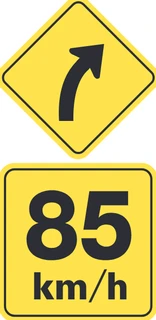 The tab under a curve sign is the recommended top speed for that curve in ideal conditions, not a limit for the whole road.p. 33
School zones and school areas
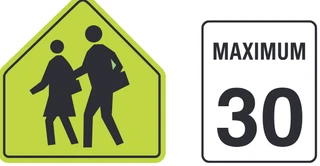 School zone: the school sign with a speed limit. Don’t go over that speed while the zone is in effect.p. 30
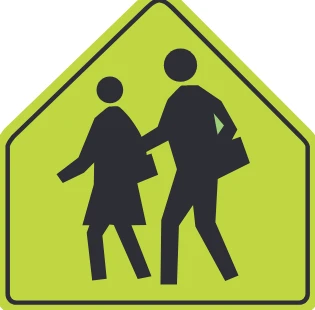 School area: the school sign with no speed limit. Children may be walking or crossing, so drive with care.p. 31
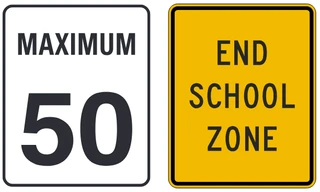 End of the zone: a sign with a higher speed limit, or a sign marking the end of the school zone.p. 31
Playground zones and playground areas
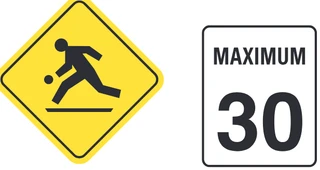 Playground zone: the playground sign with a speed limit. Don’t go over that speed while the zone is in effect.p. 31
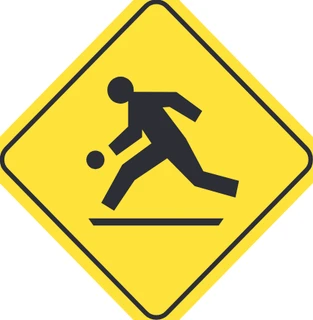 Playground area: the playground sign with no speed limit. Children may be near, so drive with care.p. 32
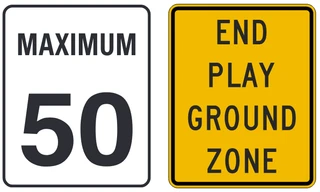 End of the zone: a sign with a higher speed limit, or a sign marking the end of the playground zone.p. 32
| Days | Times | Speed limit |
|---|---|---|
| Every day | 8:30 a.m. to one hour after sunset | 30 km/h |
- The big difference from school zones: playground zones apply every day, not only on school days, and they run into the evening.p. 31p. 30
- Some towns and cities use different hours. When they do, the times are posted under the playground sign.p. 31
- While the zone is in effect, you may not pass, or try to pass, a vehicle going the same way.p. 31
Construction zones
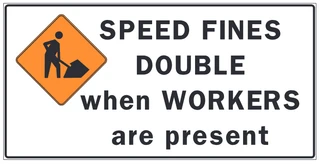 Speeding fines double in a construction zone when workers are present.p. 37
The orange construction signs, one by one: Alberta road signs and their meanings.
Other places you must slow down
More on passing emergency vehicles, tow trucks and snowplows: Emergency vehicles, tow trucks and snowplows in Alberta. The demerit points for speeding: Demerit points in Alberta.