

Lane selection and position in your lane
Most major roadways and highways are divided into lanes, with lines on the road surface to indicate where your vehicle should travel and the rules of lane driving that you should follow. Choose the lane that best meets your needs for safety and getting to your destination. Plan ahead. Do not leave lane changes to the last minute.
When a roadway has been divided into lanes by visible marking lines on the road surface, you should drive in the centre of your lane.
Blind spots
Your inside and outside rear view mirrors will show you the traffic that is behind your vehicle. They will not show you everything to the sides or what is right beside and slightly behind in the lanes next to you. These are blind spots. Using the inside rear view mirror, the driver of Vehicle A can see Vehicle B.
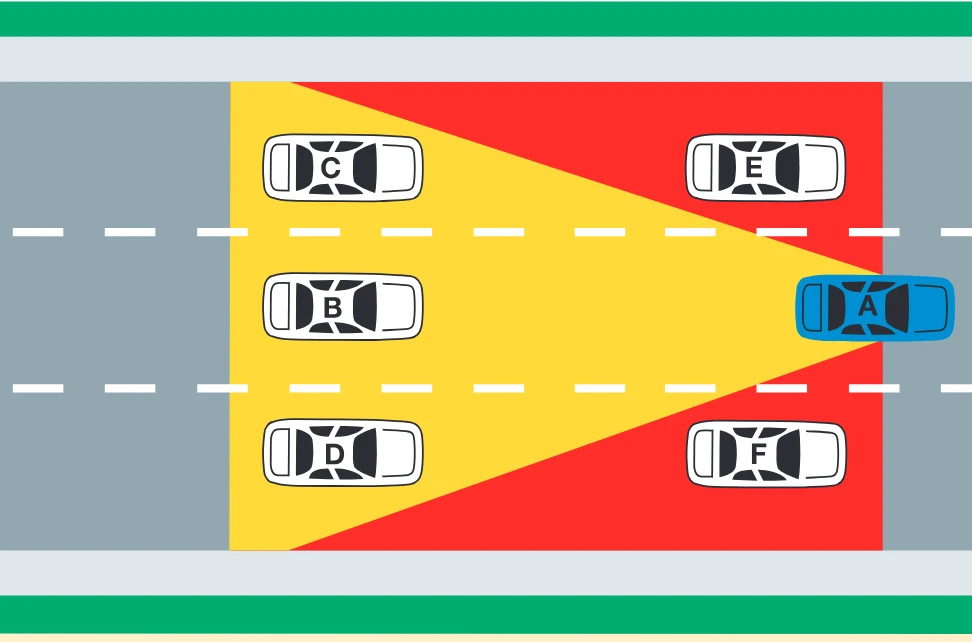
Mirror views and blind spots for vehicle A
Using the left outside mirror, the driver of Vehicle A can see Vehicle C.
The view in your inside rear view mirror should show as much of the view through your rear window as possible. The outside rear view mirrors should show a little of your vehicle on the side where the mirror is attached, as well as the area behind you in the lane next to you. They should be positioned so that from your driving position you see the horizon behind you in the middle of each mirror. Be sure your inside and outside rear view mirrors are adjusted properly to minimize blind spots.
The following pictures show what can be seen in properly adjusted mirrors. Using both outside mirrors and inside rear view mirror, the driver of Vehicle A can see Vehicles B, C, and D. The driver of Vehicle A cannot see Vehicles E and F, either in the mirrors or through peripheral (side) vision. Vehicles E and F are in Vehicle A’s blind spots. The red shading shows the blind spots for the driver of Vehicle A.