Highway driving in Alberta: merging, passing and lane changes
Highways ask for planning: choose your lane early, check your blind spots, and pass only where it is legal and safe. Here is how the Driver’s Guide says to do it.p. 70p. 71
Checked against the Driver’s Guide (Spring 2026) on .
The short version
- Merging is shared: neither the merging vehicle nor the traffic already on the highway has the right-of-way.p. 73
- Don’t slow down or stop to merge. Use the acceleration lane to reach the speed of traffic.p. 73
- Mirrors don’t show everything: always shoulder check before changing lanes.p. 71
- It is illegal to go over the speed limit while passing, and you must never drive or pass in the emergency stopping lane.p. 72p. 73
Your lane and your blind spots
Where lanes are marked, drive in the centre of yours. On a multi-lane highway, slower traffic keeps to the lane furthest right (unless turning left), leaving the left lane free for passing.p. 70p. 71
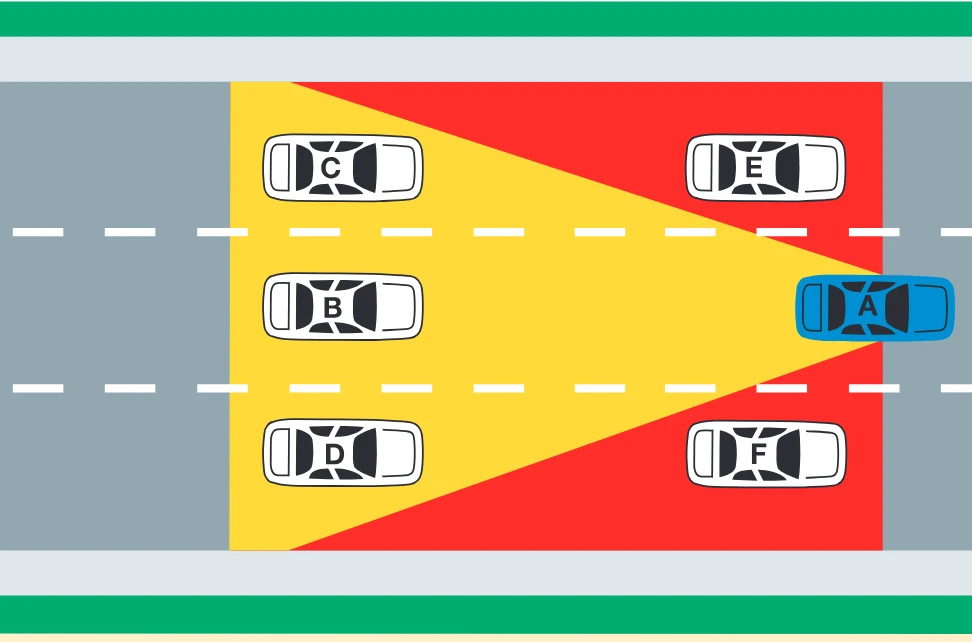
Set your mirrors so you see the horizon behind you in the middle of every mirror. The outside mirrors should show a little of your own vehicle.p. 70
To change lanes:p. 71
Merging onto a highway
The merging lane is there to get you up to the speed of the road you’re joining. Drivers behind you expect you to keep moving: slow down or stop, and you may be hit from behind.p. 73
- Check the traffic on the highway as soon as you can see the lane you’ll merge into.p. 73
- Pick your gap, and keep glancing at it as you adjust your speed.p. 73
- Signal before or when you’re in the acceleration lane, and speed up to match traffic.p. 73
- Keep shoulder checking the gap and watching your mirror for vehicles behind you.p. 73
- Once you’re past the solid white line, move into the gap when safe and legal, at or near the speed of traffic. Then turn off your signal.p. 73
 Already on the highway? When traffic is merging, move over to the next lane on the left if it’s safe, to leave the right lane for the merging vehicles.p. 73
Exiting, and weave zones
- Be in the proper lane well before your exit.p. 74
- Signal well in advance.p. 74
- Move into the deceleration lane if there is one, and do most of your slowing there. If it’s short, you may need to start slowing on the highway.p. 74
- Missed your exit? Don’t stop. Carry on to the next exit. Never stop and reverse on a highway, emergency stopping lane or shoulder.p. 74
In a weave zone, the highway entrance and exit share the same lane, so some vehicles are slowing to leave while others speed up to join. Control your speed and the timing of your lane change, and cooperate.p. 74
Passing on a two-lane highway
On a two-lane highway (one lane each way), passing is difficult and dangerous: a misjudged pass can mean a head-on collision. Pass only where it’s legal, when it’s necessary, and with extreme caution.p. 71
- Keep a safe following distance behind the vehicle, and pass only where it’s permitted and there is no oncoming traffic for a safe distance.p. 71
- Shoulder check left for anyone passing you, and signal left.p. 72
- Check once more for oncoming traffic, and that you can finish the pass while passing is still permitted. Never exceed the speed limit to pass.p. 72
- When you can see the passed vehicle in your inside mirror, shoulder check right, signal right and return to your lane at a steady speed. Then cancel your signal.p. 72
- Being passed? Stay in your lane and move to its right side so the other driver can see ahead.p. 72
Passing lanes are added lanes, often in the mountains: slower vehicles move right so others can pass on the left. Where the passing lane ends, drivers on the right merge left, and drivers on the left must let them in.p. 71
When passing is illegal
Don’t pass when:p. 72
- oncoming vehicles are too close, or you have any doubt you can finish safelyp. 72
- there is a solid yellow line on your side of the centre linep. 72
- a sign marks a no-passing zonep. 72
- you’re in a school or playground zone while it is in effectp. 72
- another vehicle has stopped to let a pedestrian cross at a crosswalk, marked or notp. 72
- a school bus has its red lights flashing and its stop arm outp. 72
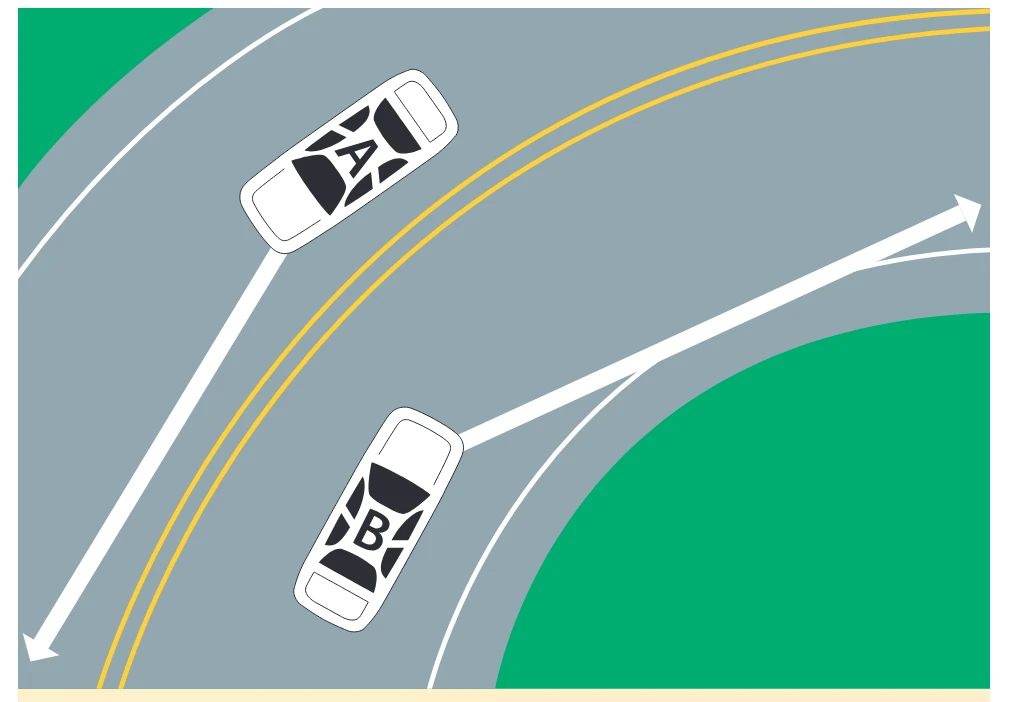
- you’re on a curve on a highway with one lane each wayp. 75
Also don’t pass near the top of a hill on a two-lane highway, where you can’t see what’s ahead.p. 76
Curves and hills
- Slow down before a curve, not in it, and stay centred in your lane by looking well ahead and around the curve.p. 75
- Keep a safe, steady speed once you’re in the curve.p. 75
- If you skid in a curve, stay off the brake and the gas, keep looking where you want to go, and make small steering corrections.p. 75
- Going up a hill, move to the right in your lane near the top, in case an oncoming vehicle has crossed the centre line.p. 76
- Going down a steep hill, adjust your speed: stopping takes longer downhill. In a manual, a lower gear helps keep the brakes from overheating.p. 76