

Hill parking
The following information applies to parking on the right side of the road. When parking facing uphill on a street with a curb, turn the front wheels to the left (toward the centre of the road). With the wheels turned, allow your vehicle to roll back slowly until the right front tire is touching the curb. This helps to prevent the vehicle from rolling into traffic if it starts to move.
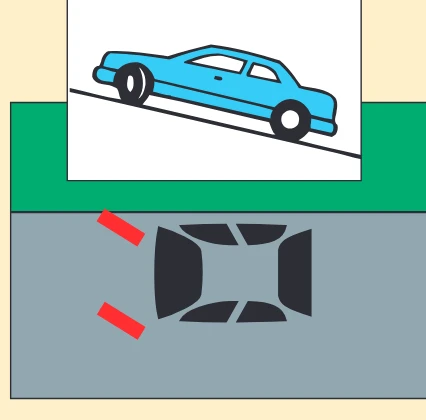
Parked facing uphill without a curb 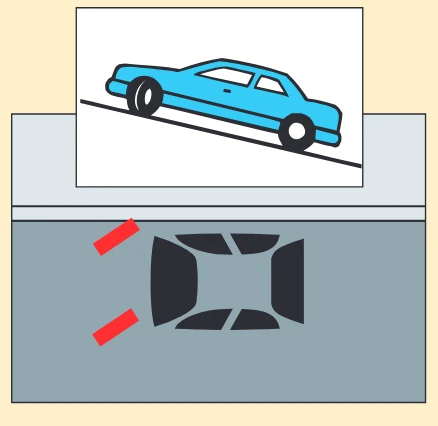
Parked facing uphill with a curb
When parking facing uphill on a street without a curb, turn your front wheels to the right (toward the edge of the road). By doing this, if the vehicle starts to move it will go off the road and not into traffic. When parking facing downhill, always turn your front wheels to the right. If there is a curb, allow your vehicle to roll to the point where your right front tire is making contact with it. With the tires turned to the right, if the vehicle starts moving it will go off the road and not into traffic.
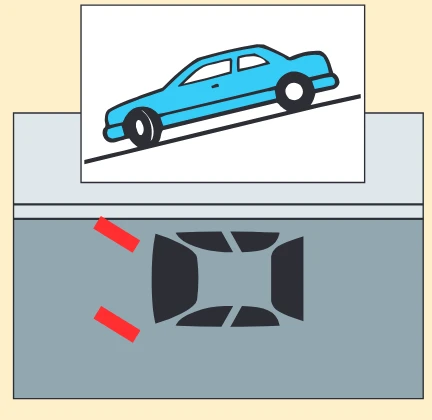
Parked facing downhill with a curb
Downhill · Uphill without curb · Uphill with curb
To prevent a parked vehicle from rolling down a hill, always set your park brake and place your transmission in park (for an automatic transmission) or low gear (for a manual transmission).
When parking on the left side of the road, turn the front wheels in the opposite direction.
Do not park here
Do not park your vehicle
- on a sidewalk or boulevard
- on a crosswalk or on any part of a crosswalk
- within an intersection
- within one and a half metres (five feet) of access to a garage, private roadway, or driveway
- alongside or opposite any street construction or obstruction when stopping or parking would obstruct traffic
- on a bridge or underpass or the approaches to a bridge or underpass
- where a traffic control device prohibits stopping or parking
No parking within five metres (16 feet) of a stop or yield sign.
No parking within five metres (16 feet) of a marked crosswalk.