

Parking rules and hill parking in Alberta
Parking takes good control of the vehicle, accurate judgement and steering skill. The test asks most about where you may not park, and which way to turn your wheels on a hill.p. 52
Checked against the Driver’s Guide (Spring 2026) on .
The short version
- Stay five metres from a fire hydrant, a stop or yield sign, and the nearest side of a marked crosswalk.p. 56
- Facing downhill, always turn your front wheels to the right.p. 55
- Facing uphill with a curb, turn them to the left and roll back until the right front tire touches the curb.p. 55
- When parallel parked, your wheels may be no more than 50 centimetres from the curb.p. 52
Where you may not park
| Don’t park within | Of |
|---|---|
| Five metres (16 feet) | A stop sign or yield sign |
| Five metres | The nearest side of a marked crosswalk |
| Five metres | A fire hydrant (if it isn’t at the curb, measure from the point on the curb nearest it) |
| Five metres | The edge of an intersecting road, unless something such as a parking meter shows parking is allowed |
| One and a half metres (five feet) | The access to a garage, private road or driveway |
Don’t park at all:p. 55
- on a sidewalk or boulevardp. 55
- on any part of a crosswalk, or within an intersectionp. 55
- on a bridge or underpass, or on the approaches to themp. 55
- beside or opposite street construction or an obstruction, where you would block trafficp. 55
- beside another vehicle, where you would be double-parkedp. 56
- at or near a fire, explosion, crash or other incident, where you would block traffic or emergency crewsp. 56
- where a sign or signal prohibits stopping or parkingp. 55
Parking on a hill
Turn your wheels so that if the vehicle starts to roll, it goes into the curb or off the road, not into traffic. This is for parking on the right side of the road.p. 55
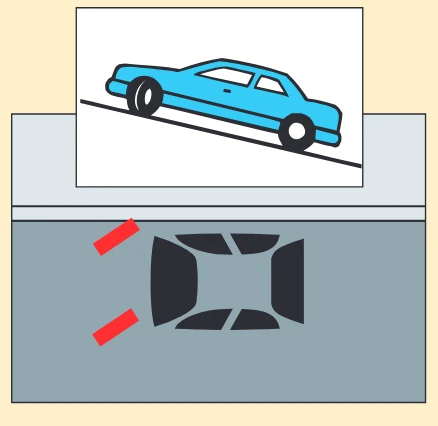 Uphill, with a curb: turn your front wheels to the left, toward the centre of the road, and let the vehicle roll back slowly until the right front tire touches the curb.p. 55
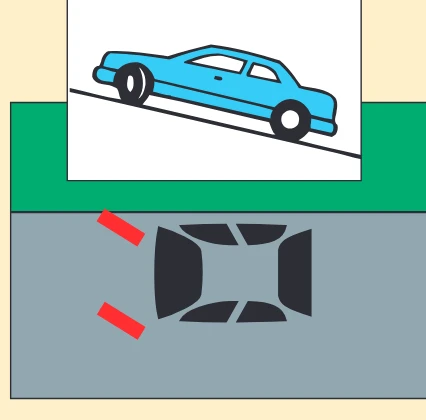 Uphill, no curb: turn your front wheels to the right, toward the edge of the road.p. 55
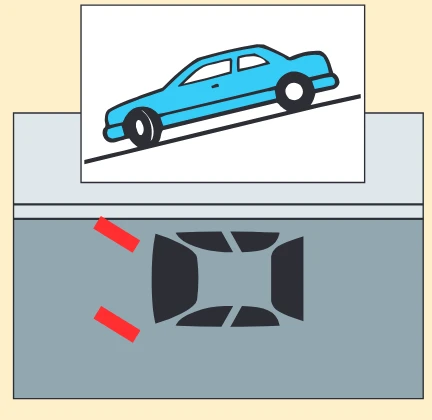 Downhill (curb or not): always turn your front wheels to the right. With a curb, roll until the right front tire touches it.p. 55
Parallel parking
To park between two vehicles at the right curb:p. 52
- Check behind you and brake gradually, well before the space, so your brake lights warn others.p. 52
- Stop beside the vehicle in front of the space, rear bumpers in line, about one metre (three feet) apart.p. 52
- Reverse very slowly, steering sharply right until you are at about a 45-degree angle to the curb.p. 52
- Straighten the wheels, then turn sharply left and reverse until you are parallel with the curb.p. 52
- By law, your wheels may be no more than 50 centimetres from the curb.p. 52
Leaving the space, with a vehicle parked in front:p. 53
Getting out on a two-way street: check your mirrors and your left blind spot, open the door no wider than you need, get out quickly, and walk to the back of the vehicle, facing traffic, to reach the curb. Getting in: approach from the front of the vehicle.p. 53
Angle and perpendicular parking
- Angle parking is used most in parking lots. Pull in slowly until your front wheel lightly touches the curb, or is within 50 centimetres (20 inches) of it.p. 53
- Backing out is hazardous because it is hard to see traffic: reverse slowly, yield the right-of-way and look carefully behind you.p. 54
- Only turn into an angle or perpendicular stall on your left when you are in a parking lot, and check for oncoming traffic before you cross its lane.p. 54