

Before you drive: pre-drive checks, steering and reversing
Good driving starts before the engine does. The Driver’s Guide sets out a routine to follow every time, and examiners expect to see it on your road test.p. 44
Checked against the Driver’s Guide (Spring 2026) on .
The short version
- In this order: lock your doors, adjust your seat, adjust your head restraint, adjust your mirrors, fasten your seat belt.p. 44
- Sit at least 25 centimetres (10 inches) from the steering wheel.p. 44
- Hands at about 9 and 3 o’clock (or 10 and 2 if the wheel’s design calls for it).p. 48
- Reverse at a crawl or slow walking speed, and only when your path is clear. Reversing into an intersection or crosswalk is illegal.p. 51
Walk around your vehicle
Before you get in, walk around the vehicle to check for children, pedestrians and anything in its path. Check that the tires are properly inflated, and look around and under the vehicle for fluid leaks or other problems. Parked on a road? Walk facing the traffic in the lane next to you.p. 44
The pre-drive habits, in order
- Lock your doors. It keeps unwanted people out, and makes the doors less likely to open in a collision.p. 44
- Adjust your seat. Sit at least 25 cm (10 inches) from the wheel, see over it, keep your elbows slightly bent, and make sure you can work the pedals (and push the clutch fully down in a manual).p. 44
- Adjust your head restraint. The centre should be level with the tops of your ears, ideally less than 10 cm (four inches) behind your head. Check your passengers’ too.p. 45
- Adjust your mirrors. Frame the whole rear window in the inside mirror, and set the outside mirrors so you just see a small part of your own vehicle.p. 45
- Fasten your seat belt. The lap belt goes low and snug over your hips, the shoulder belt across your chest and shoulder, never behind your back or under your arm. Air bags don’t replace it.p. 45
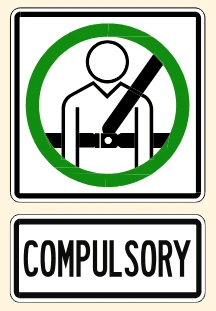 The law requires you to wear your seat belt. Who is fined for unbuckled passengers, and car seats for children: Seat belts and child car seats in Alberta.p. 45
Moving off from the curb
Hand position and steering
- Think of the wheel as a clock: left hand at about 9 o’clock, right hand at about 3. If the wheel’s design doesn’t allow it, use about 10 and 2.p. 48
- Turn corners using hand-over-hand steering. To straighten out, use hand-over-hand again, or let the wheel slide back through your loosened grip while keeping contact.p. 48
How to reverse safely
Always reverse at a crawl or slow walking speed, and only when your path is clear of traffic, pedestrians and obstacles. Before backing out of a driveway, walk around the vehicle to check behind it.p. 51
In a straight line:p. 51
- Put your left hand at the top of the wheel, shift slightly onto your right hip, and rest your right hand on the back of the passenger seat.p. 51
- Look over your right shoulder through the rear window, and reverse slowly with your foot covering the brake.p. 51
- Glance to the front so the front of the vehicle doesn’t hit anything.p. 51
- To correct, turn the wheel no more than a quarter turn, in the direction you want the rear to go.p. 51
Turning while reversing:p. 51